How to Choose a Hairstyle That Suits Your Face Shape
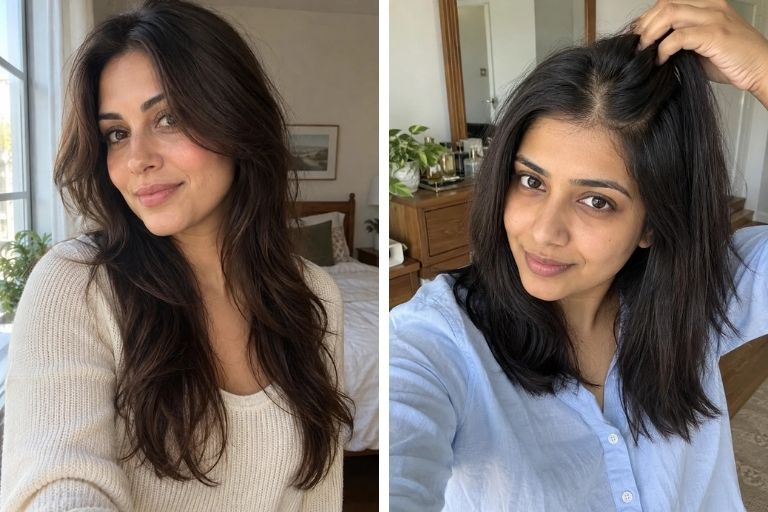
A haircut can look incredible in a photograph and completely different when you try it yourself. The fringe sits too high, the layers fall in the wrong place, or the bob that looked so flattering on someone else doesn’t frame your face the way you expected.
Often, the problem isn’t the haircut. It’s how the shape of the hair interacts with your features.
A hairstyle creates an outline around your face. Its length, volume, parting, and layers influence where people naturally look. Small changes can make your cheekbones more noticeable, draw attention to your eyes, or create a softer outline around your jaw.
Understanding these effects makes choosing a hairstyle much easier.
You don’t need a perfectly oval face or a haircut that follows traditional beauty rules. You need to understand your proportions, consider your natural hair texture, and decide what you want your hairstyle to emphasize.
What Actually Makes a Hairstyle Flattering?
Face shape is useful, but it doesn’t tell the whole story.
Two women with round faces may look completely different in the same bob. One might have thick, wavy hair and a strong jawline. The other might have fine, straight hair and softer features.
Their haircuts may need different lengths and layers even though they share the same general face shape.
When choosing a hairstyle, consider five things:
- Face proportions: The relative width of your forehead, cheekbones, and jaw.
- Hair texture: Whether your hair is straight, wavy, curly, or coily.
- Hair density: How much hair you have across your scalp.
- Styling commitment: How much time you want to spend maintaining the look.
- Personal preference: Which facial features and hairstyle details you enjoy emphasizing.
The most flattering hairstyle isn’t necessarily the one that makes your face look more oval.
It’s the one that creates the appearance you want while working with your natural hair.
How to Determine Your Face Shape at Home
Start with a mirror, good natural lighting, and your hair pulled gently away from your face.
You don’t need to buy anything or download a special app.
Step 1: Look at Your Forehead
Notice whether your forehead appears wider, narrower, or roughly the same width as your jaw.
A wider upper face and narrower chin may suggest a heart-shaped outline.
A relatively narrow forehead paired with a wider jaw may suggest a triangular or pear-shaped outline.
Step 2: Find the Widest Part of Your Face
Look at the area around your cheekbones.
If your cheeks are the widest part and your jawline is softly curved, your face may appear round.
If your cheekbones are noticeably wider than both your forehead and jaw, your outline may be closer to a diamond shape.
Step 3: Examine Your Jawline
A square face often has a more angular lower outline.
A round face usually has a softer curve.
A heart-shaped face typically narrows toward the chin.
Don’t worry about fitting perfectly into one category. Most people have a combination of features.
Step 4: Compare Face Length and Width
Look at the distance from your forehead to your chin compared with the width across your face.
If your face appears noticeably longer than it is wide, you may have an oblong or oval outline.
If its length and width appear relatively similar, it may look rounder or squarer, depending on your jaw.
Step 5: Take a Straight-On Photograph
A photograph can help you see your overall facial outline without focusing on individual features.
Keep the camera approximately at eye level and avoid standing too close to a wide-angle phone lens, which can distort proportions.
Use the photograph as a general guide rather than a precise measurement.
Common Face Shapes at a Glance
| Face Shape | General Characteristics | Visual Details to Explore |
|---|---|---|
| Round | Softer jaw, relatively similar length and width | Crown height, longer front pieces, side parts |
| Square | Defined jaw, relatively balanced upper and lower widths | Waves, blunt lines, soft face framing |
| Oval | Face longer than wide, relatively balanced outline | Different lengths, fringes, and volume placement |
| Heart | Wider upper face, narrower chin | Movement near the jaw, side fringes |
| Diamond | Cheekbones wider than forehead and jaw | Chin-length movement, forehead framing |
| Oblong | Noticeably elongated outline | Side volume, waves, fringes |
| Triangle/Pear | Jaw wider than forehead | Movement around temples and upper sections |
These descriptions are broad styling references, not scientific categories with exact boundaries.
If you fall between two shapes, that’s perfectly normal.
How Hair Length Changes Your Facial Proportions
Before choosing a hairstyle for your face shape, understand what hair length actually does.
The point where your hair ends creates a visual line.
A chin-length bob draws attention toward the lower face. A shoulder-length haircut places that line farther down. Long hair creates an extended outline around your shoulders and upper body.
Different lengths also affect where your hair can hold volume.
Short Hair: More Attention on the Face and Neck
Pixies and cropped bobs expose more of your facial outline.
They may emphasize the jaw, cheekbones, eyes, and neck because there’s less hair surrounding those areas.
A short haircut with height at the crown can also create a more vertical silhouette.
If you enjoy showing your facial features, shorter hair may be appealing.
However, consider your natural texture and how much styling the cut requires.
Medium Hair: More Flexibility Around the Jaw and Shoulders
Shoulder-length hair offers several options for face framing.
You can introduce layers around the cheeks, leave a strong cutting line near the shoulders, or add movement with waves.
A collarbone-length bob is also a useful transition if you’re considering shorter hair but aren’t ready for a dramatic change.
Long Hair: More Room for Layers and Movement
Long hair can create a continuous vertical outline.
You can change the appearance by adding layers around your face, moving your part, or creating volume through the lengths.
If your hair has lower density, discuss how much layering it can support without leaving the ends sparse.
Long hair isn’t automatically unflattering on any face shape.
The placement of its layers and volume matters more than length alone.
Hairstyles for Round Faces
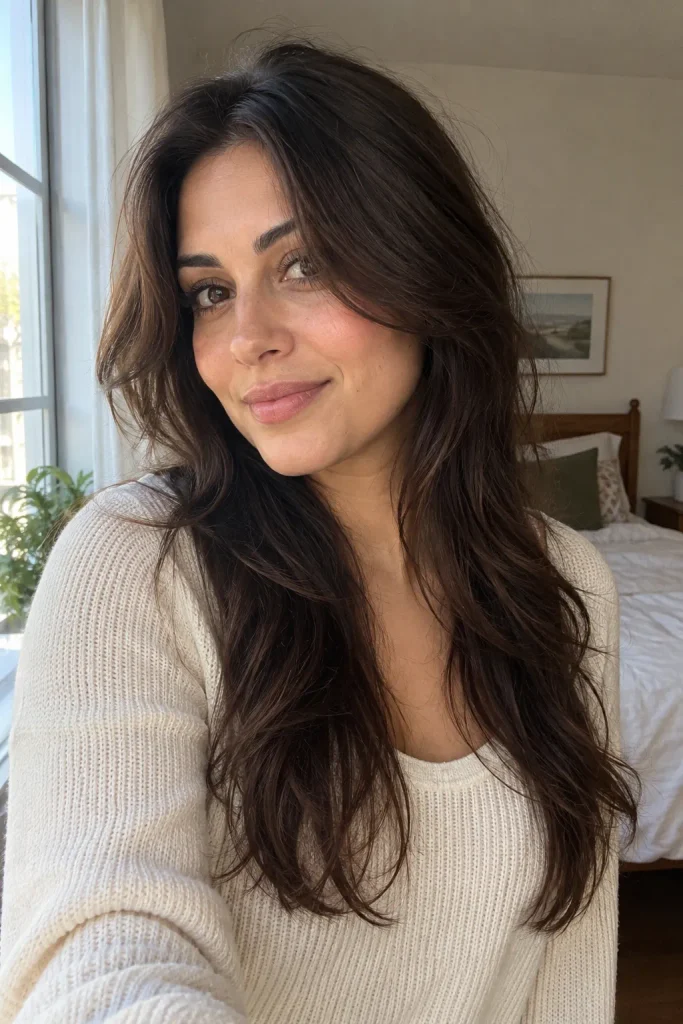
Round faces often have softly curved jawlines and cheek areas.
Some people prefer to emphasize those soft features. Others want a hairstyle that creates a more elongated-looking outline.
If your goal is visual length, you might enjoy a lob that extends below the chin or a hairstyle with subtle height at the crown.
Long front sections can create vertical lines beside your face.
Side parts can also change the symmetry of the overall hairstyle.
Styles Worth Considering
- Collarbone-length bobs
- Long layered hairstyles
- Pixies with crown volume
- Side-parted lobs
- Shoulder-length cuts with face-framing pieces
A short bob can also look beautiful on a round face.
The important decision is where the perimeter falls and how much volume sits around your cheeks.
What to Avoid Assuming
Don’t assume round faces must avoid bangs or short hair.
A textured pixie or short fringe may create exactly the look you want.
Instead of following a restriction, decide whether you prefer a rounded, angular, or elongated silhouette.
Hairstyles for Square Faces
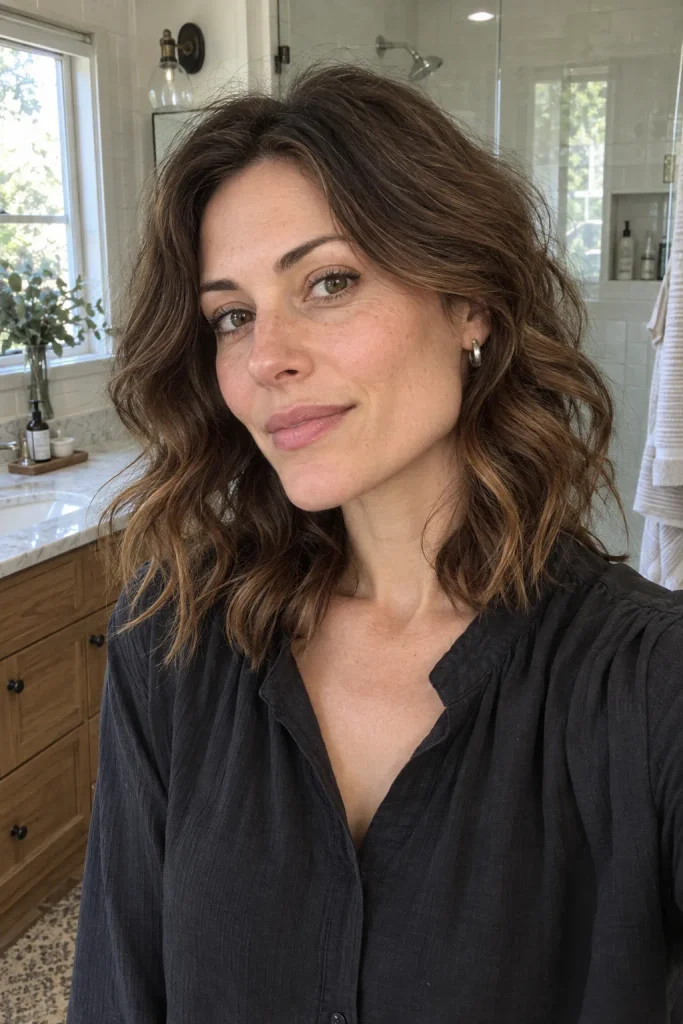
A square face generally has a defined jawline and relatively similar forehead and jaw widths.
That structure gives you two interesting styling directions.
You can emphasize the angles with a sharp haircut or introduce softer lines through waves and layering.
For a Defined, Modern Look
A blunt bob can complement a strong jawline.
A center part and sleek finish may create a structured appearance.
A short crop can also keep attention on your facial features.
For a Softer Appearance
Waves introduce curved lines around the face.
Curtain bangs and loose face-framing layers can create movement around the cheekbones and jaw.
A shoulder-length cut may also provide additional length for soft bends.
Neither approach is inherently better.
The decision depends on whether you enjoy emphasizing your natural angles or prefer a softer outline.
Hairstyles for Oval Faces
An oval face is generally longer than it is wide, with relatively balanced proportions.
Because the forehead, cheekbones, and jaw don’t necessarily dominate the outline, many different hairstyle shapes can work.
But your face shape alone won’t tell you whether a pixie, bob, or long haircut is the right choice.
Think about which feature you want to highlight.
A short bob draws attention toward the jaw.
Curtain bangs can frame the eyes and cheekbones.
A pixie exposes more of the face and neck.
Long layers may preserve your length while introducing movement.
Styles to Explore
- Blunt bobs
- Long layered haircuts
- Pixie cuts
- Curtain bangs
- Shag haircuts
- Shoulder-length waves
If your hair is naturally curly or coily, consider how the finished shape changes as it dries.
A reference photograph with straight hair may not show how the same length behaves with curls.
Hairstyles for Heart-Shaped Faces
Heart-shaped faces typically have a wider forehead or upper face and a narrower chin.
If you want to create more fullness around the lower face, look for movement near the jaw.
A chin-length wavy bob may introduce width around that area.
A shoulder-length style with soft layers can also add movement below the cheeks.
Side-swept bangs may create an asymmetrical line across the forehead.
Hairstyles to Consider
- Chin-length wavy bobs
- Collarbone-length haircuts
- Side-swept fringes
- Long hair with lower face-framing layers
- Textured pixies
You don’t need bangs simply because your forehead is wider.
An open forehead can look striking, particularly with a short haircut.
Choose a fringe because you enjoy the style and are comfortable maintaining it.
Hairstyles for Diamond Faces
A diamond face generally has prominent cheekbones with a narrower forehead and jaw.
The cheekbones already create a strong focal point.
You can choose a hairstyle that emphasizes them or introduce more visual fullness around the forehead and lower face.
A chin-length bob with movement around the jaw may change the balance of the silhouette.
A side fringe or curtain bangs can introduce additional detail near the forehead.
Long layers may also follow the natural contours of the face.
Styles to Explore
- Side-parted bobs
- Chin-length wavy haircuts
- Layered medium-length hairstyles
- Side-swept bangs
- Long face-framing layers
If you love your cheekbones, try tucking one side of your hair behind your ear.
This simple change may make them more noticeable without requiring a haircut.
Hairstyles for Oblong Faces
Oblong faces appear noticeably longer than they are wide.
If you want a hairstyle that creates more visual width, focus on movement around the sides.
A softly waved lob can introduce volume near the cheeks.
A fringe creates a line across the forehead, changing the visual proportions of the upper face.
Medium-length hair with layers may provide both movement and styling flexibility.
Hairstyles to Consider
- Shoulder-length waves
- Chin-length bobs
- Curtain bangs
- Full fringes
- Layered medium-length cuts
Long hair can work beautifully too.
You might simply prefer soft waves or face-framing pieces rather than a completely straight, flat silhouette.
Hairstyles for Triangle or Pear-Shaped Faces
A triangle-shaped face generally has a lower face that appears wider than the forehead.
If you enjoy a balanced-looking silhouette, you might experiment with movement around the temples or upper sections.
Curtain bangs and side fringes can add visual interest near the forehead.
A textured crop may also create shape around the crown.
However, a strong jawline can look beautiful with a sleek blunt haircut.
There’s no need to disguise it.
Hairstyles to Explore
- Layered bobs
- Side-swept bangs
- Textured pixies
- Shoulder-length cuts
- Hairstyles with soft crown volume
Your hair’s natural texture should help determine how much volume you can create and maintain.
The Role of Hair Texture and Density
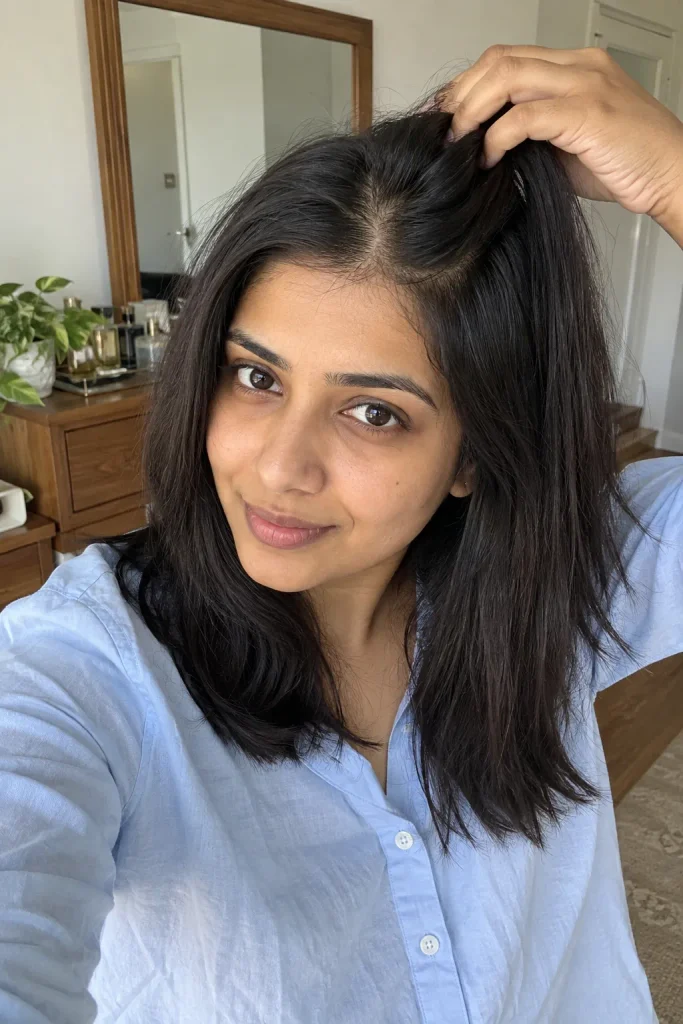
Two people can have the same face shape and still need completely different haircut techniques.
One may have fine, straight strands that fall close to the scalp.
Another may have dense curls that expand outward as they dry.
Their hairstyles create different silhouettes, even at similar lengths.
Straight Hair
Straight hair often makes the cutting line more noticeable.
Blunt bobs and sleek lobs can create defined outlines.
If your hair is fine, a strong perimeter may help the ends appear fuller.
Wavy Hair
Waves create natural bends and movement.
Strategic layers may influence where that movement sits, but excessive layering can make some haircuts lose their shape.
Consider how your waves behave when air-dried.
Curly Hair
Curls may become shorter-looking as they dry because of shrinkage.
The same haircut can appear rounded, triangular, or elongated depending on how the curls fall and where layers are placed.
Choose a hairstylist experienced with your curl pattern.
Coily Hair
Coily hair can support many different shapes, including rounded natural styles, tapered cuts, twists, and updos.
Consider shrinkage, density, and the amount of manipulation needed to maintain your preferred look.
Avoid repeated excessive tension around the hairline.
The American Academy of Dermatology warns that tight hairstyles can contribute to traction alopecia, a form of hair loss caused by persistent pulling.
Fine Hair Versus Low-Density Hair
Fine hair describes individual strand thickness.
Hair density describes how many strands grow across an area of the scalp.
You can have fine hair with high density or coarse hair with relatively low density.
This distinction matters when deciding how many layers to add.
A heavily layered haircut may look full on dense hair but leave lower-density ends appearing sparse.
How Bangs Change the Appearance of Your Face

Bangs can alter the entire impression of a haircut without changing its overall length.
They create new lines around the forehead, eyes, and cheekbones.
The effect depends on their length, thickness, and direction.
Curtain Bangs
Curtain bangs separate near the middle of the forehead and fall toward the sides.
They create soft framing around the eyes and cheekbones.
They may be worth considering if you want a fringe that blends into longer layers.
Blunt Bangs
A blunt fringe creates a defined horizontal line.
It can produce a graphic, structured appearance.
The exact length matters. A fringe ending above the eyebrows looks different from one that falls close to the eyelashes.
Side-Swept Bangs
A side fringe creates a diagonal line across the forehead.
It may introduce asymmetry and change where attention falls.
Wispy Bangs
Wispy bangs are lighter and allow more forehead visibility.
They may appeal to someone who wants a less dense fringe.
Before Getting Bangs
Check whether you have cowlicks around the hairline.
Ask your stylist how the fringe will behave without a professional blowout.
Also consider how frequently you are comfortable trimming it.
Bangs can be relatively simple to style, but some people find them more demanding than the rest of their haircut.
A Practical Hairstyle Decision Guide
Now that you understand how different hairstyle details work, you can narrow your options.
Rather than choosing from hundreds of photographs, start with the result you want.
| Your Main Goal | Hairstyle Features to Explore |
|---|---|
| Emphasize cheekbones | Tucked bobs, cheekbone-length framing |
| Draw attention to the eyes | Curtain bangs, fringes, short crops |
| Highlight the jawline | Chin-length bobs, sleek styles |
| Create a longer-looking outline | Longer front pieces, crown height |
| Add visual width around the cheeks | Waves, side layers, textured bobs |
| Preserve long hair | Subtle layers, face-framing pieces |
| Make fine ends appear fuller | Blunt or softly defined perimeters |
| Work with natural curls | Shape and layers adapted to curl pattern |
| Reduce daily styling | Cuts designed around natural texture |
Choose two or three priorities.
For example, you might want to preserve your length, draw attention to your eyes, and avoid daily heat styling.
A collarbone-length cut with a soft, manageable fringe could be worth discussing.
Someone else might prioritize a defined jawline and minimal detangling. A short bob may suit those preferences better.
Test the Hairstyle Before Your Salon Appointment
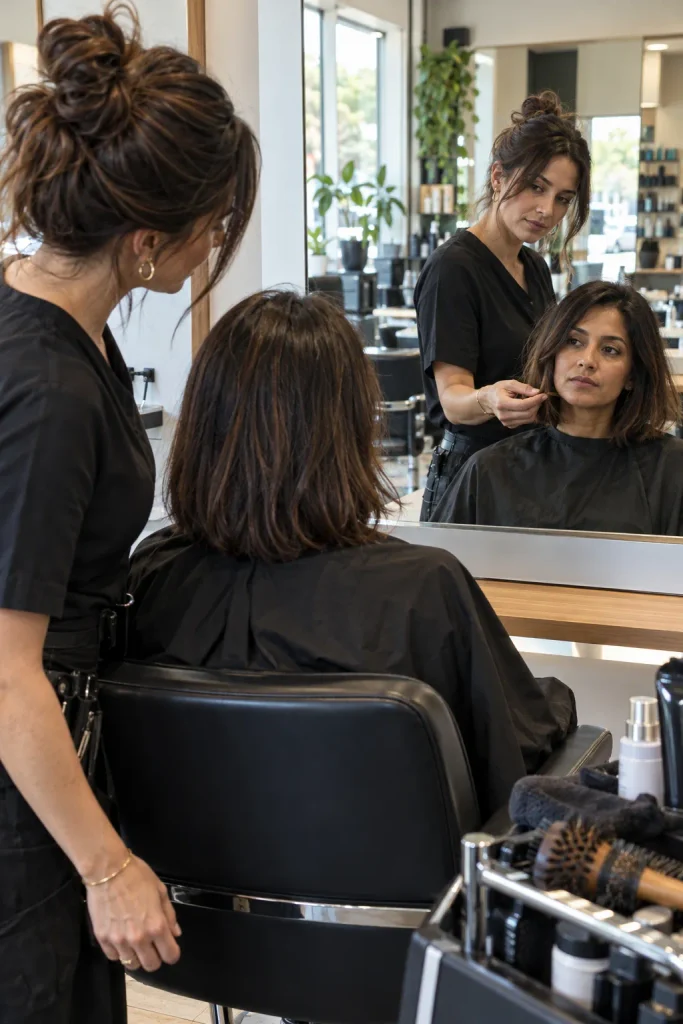
A little preparation can prevent disappointment.
Start by collecting three or four reference photographs.
Choose images showing the front, side, and back of the haircut when possible.
Look for hair textures similar to yours, rather than relying entirely on polished editorial pictures.
Identify What You Like About Each Photograph
Don’t simply say that you love the haircut.
Be specific.
Is it the length?
The fringe?
The way the layers sit around the cheeks?
The volume at the crown?
A stylist can recreate or adapt these details more effectively when you explain them.
Consider How the Style Looks Without Professional Styling
Some photographs show hair that has been carefully curled, straightened, extended, or set with products.
Ask whether the haircut itself produces the shape or whether substantial styling is necessary.
A haircut that looks beautiful after a salon blowout may behave differently when you air-dry it.
Discuss the Shortest Length You’re Comfortable With
If you’re making a dramatic change, agree on the length before your stylist begins cutting.
You can always go shorter at a later appointment.
Growing back a cut that’s much shorter than you wanted takes time.
Ask About Maintenance
Find out how frequently the hairstyle may need reshaping.
Ask what tools and products are needed to recreate the look at home.
If you rarely blow-dry your hair, make that clear.
Common Mistakes When Choosing a Hairstyle
Copying a Celebrity Haircut Exactly
A photograph may show a different hair texture, density, or professionally styled finish.
Use it as inspiration rather than expecting an identical result.
Choosing Only by Face Shape
Face shape can’t tell you how your hair behaves in humidity, how much maintenance it needs, or whether a short cut suits your routine.
Consider the full picture.
Ignoring the Back of the Haircut
A style can look completely different from the side and back.
Ask to see photographs of the full shape, particularly for bobs and pixies.
Getting Too Many Layers
Layers create movement, but they also remove weight from some sections.
For lower-density hair, excessive layering may make the ends appear thinner.
Discuss the cutting line before committing.
Choosing a High-Maintenance Style for a Low-Maintenance Routine
If you dislike styling your hair, a cut that requires daily heat and several products may become frustrating.
Choose something you can realistically maintain.
Believing You Have to Follow Face-Shape Rules
Round faces can wear pixies.
Square faces can wear blunt bobs.
Long faces can wear long hairstyles.
Traditional guidelines may suggest visual effects, but they aren’t restrictions.
Questions Worth Asking Your Hairstylist
Before the haircut, consider asking:
- How will this hairstyle behave with my natural texture?
- What will it look like when I air-dry it?
- Where should the layers begin?
- Will the ends retain enough fullness?
- How much daily styling will it require?
- Can I still tie my hair back?
- How will the haircut look as it grows?
- Would you adapt anything in my reference photograph?
A good consultation should help you understand the practical consequences of the haircut, not just how it looks immediately after styling.
Frequently Asked Questions
How do I know what hairstyle suits me?
Start with your facial proportions and decide which features you want to emphasize. Then consider your natural hair texture, density, and styling routine. These factors provide a more useful starting point than face shape alone.
What is the most flattering hairstyle for every face shape?
There isn’t one universal haircut. Bobs, layered cuts, pixies, and longer hairstyles can all be adapted to different features through changes in length, fringe, layers, and volume.
Can a round face wear short hair?
Yes. A pixie, cropped bob, or other short style can work well on a round face. Crown volume, fringe shape, and the placement of the cutting line can change the overall effect.
Are bangs suitable for every face shape?
Bangs can be adapted to many facial proportions. Their practicality depends on hair texture, growth patterns, density, and how much maintenance you’re comfortable with.
Should I choose my haircut based on my age?
Age alone doesn’t determine which haircut you can wear. Natural texture, density, personal preference, and maintenance requirements are usually more useful considerations.
Can a haircut make fine hair appear thicker?
Certain cutting shapes, particularly those with a defined perimeter, can make the ends appear fuller. However, a haircut doesn’t increase the diameter of individual strands or the number of hair follicles.
Make Your Hairstyle Work for You
Choosing a hairstyle doesn’t need to involve finding the perfect face-shape category.
It’s more useful to understand how length, layers, volume, and fringe influence the shape around your face.
Once you know what those details do, you can make more confident decisions.
You might discover that a slightly longer bob frames your jaw exactly how you want. You may prefer a soft fringe that draws attention to your eyes. Or you might decide that your current length works well and only needs more carefully placed layers.
Your hair texture, lifestyle, and preferences should guide the final choice.
The goal isn’t to make your face fit a particular hairstyle.
It’s to choose a hairstyle that fits you.
This article provides general hairstyle-selection guidance. Face-shape recommendations are aesthetic conventions rather than medical or scientific rules.